2014 Toyota 4Runner Owner’s Manual — If the engine will not start
When trouble arises
If the engine will not start even though correct starting procedures are being followed (, 173), consider each of the following points:
The engine will not start even though the starter motor operates normally.
One of the following may be the cause of the problem:
• There may not be sufficient fuel in the vehicle’s tank.
Refuel the vehicle.
• The engine may be flooded.
Try to restart the engine again following correct starting procedures.
• There may be a malfunction in the engine immobilizer system.
The starter motor turns over slowly, the interior lights and headlights are dim, or the horn does not sound or sounds at a low volume.
One of the following may be the cause of the problem:
• The battery may be discharged.
• The battery terminal connections may be loose or corroded.
The starter motor does not turn over.
The engine starting system may be malfunctioning due to an electrical problem such as an open circuit or a blown fuse. However, an interim measure is available to start the engine.
The starter motor does not turn over, the interior lights and headlights do not turn on, or the horn does not sound.
One of the following may be the cause of the problem:
• One or both of the battery terminals may be disconnected.
• The battery may be discharged.
• There may be a malfunction in the steering lock system. (vehicles with a smart key system)
Contact your Toyota dealer if the problem cannot be repaired, or if repair procedures are unknown.
Emergency start function (vehicles with a smart key system)
When the engine does not start, the following steps can be used as an interim measure to start the engine if the “ENGINE START STOP” switch is functioning normally:
 Set the parking brake.
 Shift the shift lever to P.
 Turn the “ENGINE START STOP”
switch to ACCESSORY mode.
 Press and hold the “ENGINE START
STOP” switch for about 15 seconds while depressing the brake pedal firmly.
Even if the engine can be started using the above steps, the system may be malfunctioning. Have the vehicle inspected by your Toyota dealer.
If the shift lever cannot be shifted from P
If the shift lever cannot be shifted with your foot on the brake pedal, there may be a problem with the shift lock system (a system to prevent accidental operation of the shift lever). Have the vehicle inspected by your Toyota dealer immediately.
The following steps may be used as an emergency measure to ensure that the shift lever can be shifted:
Set the parking brake.
Vehicles without a smart key
system
Turn the engine switch to the “ACC” position.
Vehicles with a smart key system
Turn the “ENGINE START STOP” switch to ACCESSORY mode.
Depress the brake pedal.
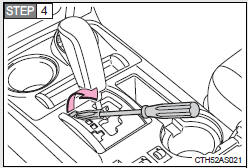
Pry the cover up with a flathead screwdriver or equivalent tool.
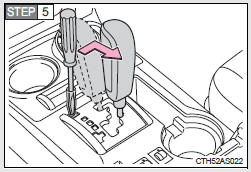
Press the shift lock override button.
The shift lever can be shifted while the button is pressed.
If you lose your keys
New genuine keys can be made by your Toyota dealer. For vehicles with the smart key system, bring the other key and the key number stamped on the key number plate. For vehicles without the smart key system, bring a master key and the key number stamped on the key number plate.
If you cannot operate back door opener
If the back door opener does not operate, there may be a problem with the back door opener system. Have the vehicle inspected by your Toyota dealer immediately.
The following steps may be used as an emergency measure to ensure that the back door can be opened from the inside.
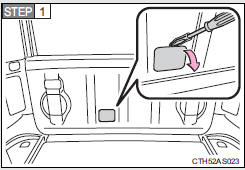
Remove the cover on the back door trim.
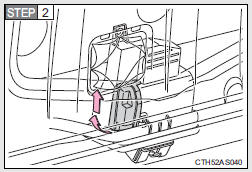
Tear the plastic film. Remove the cover.
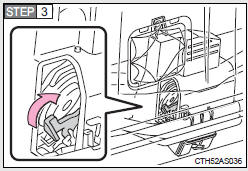
Pull the lever.
If the electronic key does not operate properly (vehicles with a smart key system)
If communication between the electronic key and vehicle is interrupted or the electronic key cannot be used because the battery is depleted, the smart key system and wireless remote control cannot be used. In such cases, the doors can be opened and the engine can be started by following the procedure below.
Locking and unlocking the doors
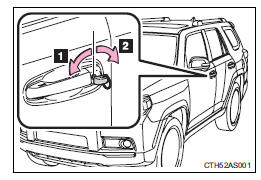
Use the mechanical key (→P. 33) in order to perform the following operations:
1. Locks all doors
2. Unlocks all doors Turning the key rearward unlocks the driver’s door.
Turning the key once again unlocks the other doors.
Starting the engine
 Ensure that the shift lever is in
P and depress the brake pedal.
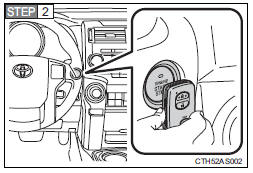
Touch the Toyota emblem side of the electronic key to the “ENGINE START STOP” switch.
If any of the doors is opened or closed while the key is being touched to the switch, an alarm will sound to indicate that the start function cannot detect the key.
 Press the “ENGINE START STOP”
switch within 10 seconds of the buzzer sounding, keeping the brake pedal depressed.
In the event that the “ENGINE START STOP” switch cannot be operated, contact your Toyota dealer.
Stopping the engine
Shift the shift lever to P and press the “ENGINE START STOP” switch as you normally do when stopping the engine.
Replacing the key battery
As the above procedure is a temporary measure, it is recommended that the electronic key battery be replaced immediately when the battery is depleted.
Changing “ENGINE START STOP” switch modes
Within 10 seconds of the buzzer sounding, release the brake pedal and press the “ENGINE START STOP” switch.
The engine does not start and modes will be changed each time the switch is pressed.
If the vehicle battery is discharged
The following procedures may be used to start the engine if the vehicle's battery is discharged.
You can also call your Toyota dealer or a qualified repair shop.
If you have a set of jumper (or booster) cables and a second vehicle with a 12-volt battery, you can jump start your vehicle by following the steps below.
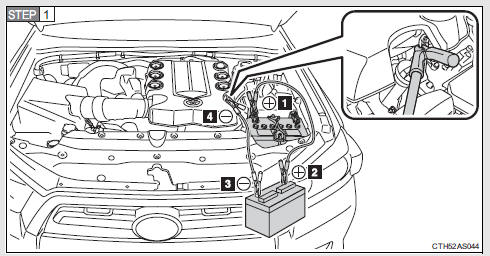
Connect the jumper cables according to the following procedure:
1. Connect a positive jumper cable clamp to the positive (+) battery terminal on your vehicle.
2. Connect the clamp on the other end of the positive cable to the positive (+) battery terminal on the second vehicle.
3. Connect a negative cable clamp to the negative (-) battery terminal on the second vehicle.
4. Connect the clamp at the other end of the negative cable to a solid, stationary, unpainted metallic point away from the battery and any moving parts, as shown in the illustration.
 Start the engine of the second
vehicle. Increase the engine speed slightly and maintain at that level for approximately 5 minutes to recharge the battery of your vehicle.
 Vehicles with a smart key system
only: Open and close any of the doors of your vehicle with the “ENGINE START STOP” switch off.
 Maintain the engine speed of the
second vehicle and start the engine of your vehicle by turning the “ENGINE START STOP” switch to IGNITION ON mode (vehicles with a smart key system) or turning the engine switch to the “ON” position (vehicles without a smart key system).
 Once the vehicle’s engine has
started, remove the jumper cables in the exact reverse order from which they were connected.
Once the engine starts, have the vehicle inspected at your Toyota dealer as soon as possible.
Starting the engine when the battery is discharged
The engine cannot be started by push-starting.
To prevent battery discharge
• Turn off the headlights and the audio system while the engine is off.
• Turn off any unnecessary electrical components when the vehicle is running at a low speed for an extended period, such as in heavy traffic.
When the battery is removed or discharged
Make sure that the key is not inside the vehicle when recharging or replacing the battery. The key may be locked in the vehicle if the alarm is activated.
Charging the battery
The electricity stored in the battery will discharge gradually even when the vehicle is not in use, due to natural discharge and the draining effects of certain electrical appliances. If the vehicle is left for a long time, the battery may discharge, and the engine may be unable to start. (The battery recharges automatically during driving.)
Precautions when the battery is discharged (vehicles with a smart key system)
• In some cases, it may not be possible to unlock the doors using the smart key system when the battery is discharged. Use the wireless remote control or the mechanical key to lock or unlock the doors.
• The engine may not start on the first attempt after the battery has recharged but will start normally after the second attempt. This is not a malfunction.
• The “ENGINE START STOP” switch mode is memorized by the vehicle.
When the battery is reconnected, the system will return to the mode it was in before the battery was discharged. Before disconnecting the battery, turn the “ENGINE START STOP” switch off.
If you are unsure what mode the “ENGINE START STOP” switch was in before the battery discharged, be especially careful when reconnecting the battery.
CAUTION
Avoiding battery fires or explosions
Observe the following precautions to prevent accidentally igniting the flammable gas that may be emitted from the battery:
• Make sure each jumper cable is connected to the correct terminal and that it is not unintentionally in contact with any other than the intended terminal.
• Do not allow the + and - clamps of the jumper cables to come into contact with each other.
• Do not smoke, use matches, cigarette lighters or allow open flame near the battery.
Battery precautions
The battery contains poisonous and corrosive acidic electrolyte, while related parts contain lead and lead compounds. Observe the following precautions when handling the battery:
• When working with the battery, always wear safety glasses and take care not to allow any battery fluids (acid) to come into contact with skin, clothing or the vehicle body.
• Do not lean over the battery.
• In the event that battery fluid comes into contact with the skin or eyes, immediately wash the affected area with water and seek medical attention.
Place a wet sponge or cloth over the affected area until medical attention can be received.
• Always wash your hands after handling the battery support, terminals, and other battery-related parts.
• Do not allow children near the battery.
NOTICE
When handling jumper cables
When connecting the jumper cables, ensure that they do not become entangled in the cooling fans or belt.
If your vehicle overheats
If your engine overheats:
 Stop the vehicle in a safe place
and turn off the air conditioning system.
 Check to see if steam is coming
out from under the hood.
If you see steam:
Stop the engine. Carefully lift the hood after the steam subsides and then restart the engine.
If you do not see steam:
Leave the engine running and carefully lift the hood.
 Check to see if the cooling fan
is operating.
If the fan is operating:
Wait until the temperature of the engine (shown on the instrument panel) begins to fall and then stop the engine.
If the fan is not operating:
Stop the engine immediately and call your Toyota dealer.
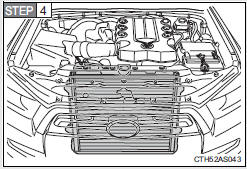
After the engine has cooled down sufficiently, check the engine coolant level and inspect the radiator core (radiator) for any leaks.
If the engine compartment cover needs to be removed.
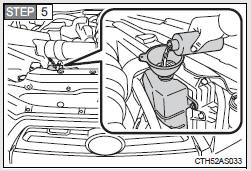
Add engine coolant if necessary.
Water can be used in an emergency if engine coolant is unavailable.
Have the vehicle inspected at the nearest Toyota dealer as soon as possible.
Overheating
If you observe the following, your vehicle may be overheating:
• The engine coolant temperature gauge enters the red zone or a loss of power is experienced.
• Steam comes out from under the hood.
CAUTION
To prevent an accident or injury when inspecting under the hood of your vehicle
• If steam is seen coming from under the hood, do not open the hood until the steam has subsided. The engine compartment may be very hot, causing serious injuries such as burns.
• Keep hands and clothing away from the fan and drive belt while the engine is running.
• Do not loosen the radiator cap, or coolant reservoir cap while the engine and radiator are hot.
Serious injury, such as burns, may result from hot coolant and steam released under pressure.
NOTICE
When adding engine coolant
Wait until the engine has cooled down before adding engine coolant.
When adding coolant, do so slowly. Adding cool coolant to a hot engine too quickly can cause damage to the engine.
If the vehicle becomes stuck
Carry out the following procedures if the tires spin or the vehicle becomes stuck in mud, dirt or snow:
 Stop the engine. Set the parking
brake and shift the shift lever to P.
 Remove the mud, snow or sand
from around the stuck tire.
 Place wood, stones or some other
material under the tires to help provide traction.
 Restart the engine.
 Shift the shift lever to the D
or R position and carefully apply the accelerator to free the vehicle.
Turn off TRAC and VSC if these functions are hampering your attempts to free the vehicle.
CAUTION
When attempting to free a stuck vehicle
If you choose to push the vehicle back and forth to free it, make sure the surrounding area is clear to avoid striking other vehicles, objects or people. The vehicle may also lunge forward or lunge back suddenly as it becomes free.
Use extreme caution.
When shifting the shift lever
Be careful not to shift the shift lever with the accelerator pedal depressed.
This may lead to unexpected rapid acceleration of the vehicle that may cause an accident resulting in death or serious injury.
NOTICE
To avoid damage to the transmission and other components
• Avoid spinning the wheels and depressing the accelerator pedal more than necessary.
• If the vehicle remains stuck even after these procedures are performed, the vehicle may require towing to be freed.
If your vehicle has to be stopped in an emergency
Only in an emergency, such as if it becomes impossible to stop the vehicle in the normal way, stop the vehicle using the following procedure:
Steadily step on the brake pedal
with both feet and firmly depress it.
Do not pump the brake pedal repeatedly as this will increase the effort required to slow the vehicle.
Shift the shift lever to N.
If the shift lever is shifted to N
After slowing down, stop
the vehicle in a safe place by the road.
Stop the engine.
If the shift lever cannot be shifted to N
Keep depressing the brake pedal
with both feet to reduce vehicle speed as much as possible.
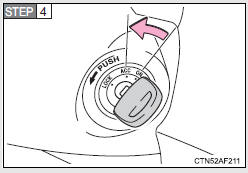
Vehicles without a smart key system: Stop the engine by turning the engine switch to the “ACC” position.
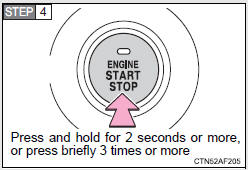
Vehicles with a smart key system: To stop the engine, press and hold the “ENGINE START STOP” switch for 2 consecutive seconds or more, or press it briefly 3 times or more in succession.

Stop the vehicle in a safe place by the road.
CAUTION
If the engine has to be turned off while driving
• Power assist for the brakes and steering wheel will be lost, making the brake pedal harder to depress and the steering wheel heavier to turn.
Decelerate as much as possible before turning off the engine.
• Vehicles without a smart key system: Never attempt to remove the key, as doing so will lock the steering wheel.
Stored owner’s manualImported HTML from the shared Autotk manuals tables. Not an official Toyota site.